











Experimental indication of a new type of mesic nuclei
Osaka, Japan – Nearly every object we interact with in our lives has a mass, but where does this mass come from? Modern physics says matter acquires its mass reflected by because of the property of the vacuum–it is not an empty space, but contains a complex structure. Investigating the system of a meson–a composite particle made of a quark, an elementary particle, and its anti-matter, anti-quark–bound to an atomic nucleus, a mesic nucleus, provides precious insight into the vacuum structure, or mass generation mechanism. Scientists are now one step closer to further understanding the origin of mass thanks to new experimental results on a completely new type of mesic nucleus.
Researchers, as part of a major international collaboration, reported evidence hinting at the existence of a never-before-seen but predicted exotic bound state known as an η′-mesic nucleus. These valuable findings will be published this month in Physical Review Letters.
Physicists have theorized that under certain conditions, short-lived particles called mesons – which only exist for less than ten-millionth of a second – can become temporarily trapped inside a nucleus, forming an exotic bound system. Measuring mesic nuclei could help scientists understand how the strong nuclear force, which binds atomic nuclei together, behaves and how the vacuum structure changes in extremely high-density environments.
“One particle of particular interest is the η′ meson,” says senior author Kenta Itahashi. “It is unusually heavy compared with related particles, and physicists expect that its mass changes when it exists inside nuclear matter. Observing this phenomenon would provide valuable information about how particle masses are generated in the universe.”
To search for the η′-mesic nuclei, the international collaboration carried out a high-precision experiment using a powerful particle accelerator in GSI Helmholtzzentrum für Schwerionenforschung, Germany. They utilized a beam of high-energy protons bombarded on a carbon target to produce η′-mesic states. The energetic proton beam excites the carbon nucleus, producing η′ mesons, which form a bound state with the carbon nucleus with a certain probability. The excitation energies of the carbon nuclei were measured by analyzing the energy of deuterons –the simplest atomic nucleus made of one proton and one neutron– produced forward in the reaction using a high-resolution spectrometer, Fragment Separator (FRS). Researchers employed a special detector called WASA, which was originally developed and constructed in Uppsala, Sweden, to selectively measure high-energy protons that get out from the target, looking for signs that an η′ meson had been created and captured inside the nucleus, otherwise known as decay signals.
“With our new experimental setup combining the FRS and the WASA, we can identify structures in the data that match theoretical signatures of η′-mesic nuclei,” explains lead author Ryohei Sekiya. “Our analysis suggests that these bound states were indeed formed.”
The resultant excitation spectrum of the carbon nucleus measured in the experiment is displayed in Fig, indicating possible formation of the η′-mesic nuclei. The team’s findings indicate that the mass of the η′ meson may decrease inside nuclear matter, supporting theoretical predictions and providing rare experimental insight into how the properties of particles change in super high-density environments.
“Our measurements provide important new clues about how mesons behave in nuclear matter,” says Itahashi. “This brings us closer to answering deep, fundamental questions about how matter acquires mass, as well as how the vacuum structure changes inside atomic nuclei.”
Future experiments are planned to increase the precision of measurements and search for additional decay signals that could confirm the existence of η′-mesic nuclei. As researchers continue their search, each new result furthers our understanding of the fundamental physical laws that govern the universe.
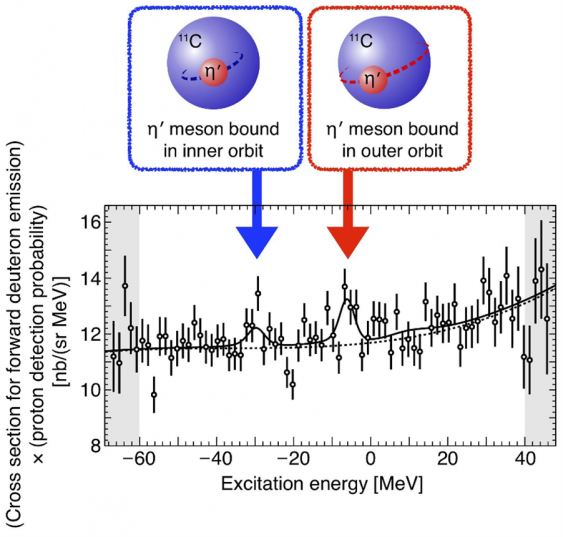
Excitation-energy spectrum of the carbon-11 nucleus obtained in the present experiment. The excitation energy on the horizontal axis is defined such that zero corresponds to the production of an η′ meson at rest in vacuum. Negative values correspond to bound states of the η′ meson and the nucleus. The circles represent the experimental data, and the vertical bars indicate statistical uncertainties. The solid curve shows the theoretical spectrum that best reproduces the experimental data, while the dotted curve represents the estimated contribution from background processes. The two observed peak structures suggest the existence of η′ meson bound states in an inner (blue) and outer (blue) nuclear orbits in the carbon-11 nucleus.
The article, “Excitation Spectra of the 12C(p,d) Reaction near the η’-Meson Emission Threshold Measured in Coincidence with High-Momentum Protons,” will be published in Physical Review Letters at https://doi.org/10.1103/6vsl-ng7x
Related links
-
Department of Physics, Nuclear Experiment Group
- Eurkalert!
- AlphaGalileo
- Asia Research News
- ResOU(Research at Osaka University)website